Valley County Pathways Master Plan
Prepared by the Valley County Pathways Committee
August 15, 2005
Questions regarding this plan should be directed to Steve Stuebner, 484-0295 or sstuebner@tamarackidaho.com
Executive Summary
What is the urgency for creating a Valley County Pathway System?
Since Tamarack Resort was fully permitted and authorized to begin development in 2003, real estate development around the resort area and in Valley County in general has been sprouting at a frenetic pace. The building boom is happening from McCall to Cascade, and the formerly sleepy town of Donnelly is in the epicenter, with numerous projects now under construction and more on the way.
The Valley County Pathways Committee has developed a concept master plan to present to the Valley County Planning & Zoning Commission in a timely fashion, knowing that new developments present new opportunities to develop existing and new pathway corridors. If the Valley County P&Z agrees with the Pathway Committee’s vision, we must act now to reserve key pathway corridors before they are bulldozed or paved over. As new subdivisions and other developments come before the P&Z Commission, the county can require project sponsors to provide an easement along key pathway corridors and encourage them to develop pathways prior to approving a project.
Purpose and Need
Why is it important for Valley County to develop a valley-wide pathway system?
Research and experience related to existing pedestrian pathway and greenway systems across the United States indicate that pathways create multiple public benefits.
Pathways:
□ Create new opportunities for recreation and for people to commute to work or shopping areas without using fossil fuels.
□ Boost local economies.
□ Provide transportation links to culturally or historically valuable areas.
□ Tie together parks, schools, waterways and communities.
□ Create opportunities for people to improve physical fitness and healthy lifestyles.
□ Enhance a community’s quality of life.
□ Preserve open space corridors.
The 2000 Leisure Travel and Recreation Study[1], performed for the Idaho Department of Parks and Recreation, shows that hiking, horseback riding, mountain biking and cross-country skiing are among the most important recreation pursuits by residents and non-residents. The 2002 Idaho Outdoor Recreation Survey[2] shows that Idaho residents enjoy hiking and biking more than any other recreation activities. Clearly, there is strong public demand from residents and non-residents for the type of recreation opportunities that will be accessible to the public via the Valley County Pathways System.

Identification of Pathway Corridors
The Valley County Pathways Committee has identified a number of proposed pathway corridors in Long Valley that could create an outstanding linked pathway system in Long Valley. The proposed corridors are preliminary, and more field work is needed to meet with adjacent landowners and neighbors to gauge public support and identify any issues or concerns.
□ Old Railroad Right of Way – The Old Union Pacific Railroad Right of Way affords Valley County an opportunity to develop the longest pathway in Long Valley that wouldn’t be adjacent to a road or highway. This is critical because it will provide recreationists with a nice pathway corridor away from motorized vehicles in a quiet setting.
□ Shoreline of Lake Cascade – There is great potential to develop pathway sections around Lake Cascade for two reasons: 1) The Bureau of Reclamation, a federal agency that manages the reservoir, owns more than 50 percent of the property around the lake, and the Boise National Forest owns substantial portions of the southwest corner of the lake; 2) The BOR is supportive of developing a pathway around Lake Cascade from a policy level. In its 2002 Resource Management Plan for Lake Cascade, the BOR recommends Recreation Objective 2.10.3: “Seek opportunities to link trail segments over time into a contiguous system that stretches completely around the reservoir (Lake Cascade RMP, Page 5-36).”
□ Farm to Market Road – Farm to Market Road between McCall and Donnelly is a popular and scenic bicycle route. It provides access to many private homes along the road, the Jug Mountain Ranch development (325 home sites), Roseberry and several other historic sites. Because Farm to Market Road is a key access route to areas with public trails, such as in Jug Mountain Ranch, and to historic sites, it makes sense to study this corridor as a place for a detached pathway on the east or west side of the existing road.
□ West Mountain Road – The Valley County Pathways Committee has contemplated the need to develop a multiple-use pathway (i.e. open to motorized travel) between Donnelly and McCall. West Mountain Road seems to be the most logical choice for a motorized pathway corridor because it would provide a close link to No Business Saddle and Red Ridge, where there are additional motorized trails on National Forest land.
□ East Roseberry Road – Either striped bike lanes or a detached pathway should be developed between Donnelly and the historic town of Roseberry on Roseberry Road. Because of the existing popularity of Farm to Market road as a bicycle destination, and the potential to develop a loop system between Farm to Market Road and the old RR ROW back to McCall, East Roseberry Road should receive priority for funding and development.
□ West Roseberry Road – Either striped bike lanes or a detached pathway should be developed between Donnelly and the junction of Roseberry and Norwood, connecting to the future extension of West Roseberry to Tamarack Falls.
□ East Lake Fork Road – Existing bike lanes have been striped between Jug Mountain Ranch and Lake Fork on East Lake Fork Road. If this road becomes a major collector, it would make sense to widen the bike lanes or work on developed a detached pathway on this section of road.
□ West Lake Fork Road – It may make sense to work toward striped bike lanes or a detached pathway on West Lake Fork Road in the event that the old RR ROW is developed into a pathway from Donnelly to McCall. This would allow cyclists to travel out to Lake Fork either on the old RR ROW or on Farm to Market Road, and then loop back to town.
□ Old State Highway – South of the Gold Fork Arm, the Valley County Road & Bridge Department plans on getting a 100-foot right of way along Old State Highway between Kantola Lane and points north to the point where the highway goes into the Gold Fork Arm of the reservoir. This right of way will allow for a detached pathway on Old State Highway in the future.
□ Kantola Lane/Day Star/West 4 – Kantola Lane will become a major transportation corridor, a “collector,” as the primary entrance to The Reserve at Lake Cascade. Day Star Lane, on the north boundary of the development, will become another major road corridor with a 100-foot ROW. And West 4 also will become a major collector to serve existing neighborhoods and new developments. The Pathways Committee recommends that the county should develop a detached pathway on Day Star Lane to connect to Old State Highway, then to either West 4 or Kantola as a bike lane loop for local residents in the future. Further, the committee believes that the county should develop detached pathways along Day Star Lane on the south side of the road, on the east side of Old State Highway, and on the south side of West 4 so that the pathways run alongside new developments.
□ Day Star/Homer/Beverly – As Day Star turns south, the pathway committee recommends a detached pathway continuing on the east side of Day Star. Where Day Star connects with Homer, the detached pathway should continue on the south side of Homer to Beverly, and then on the east side of Beverly.
□ Norwood Lane – If the RR ROW corridor does not pan out as a regional pathway corridor, Norwood is expected to become another major collector road between McCall and Donnelly in the middle of the valley. This road would become a good alternative to the RR ROW corridor if the need arises, and if it doesn’t, then Norwood may be close enough to the RR ROW that new developments proposed in this area should be required to develop connecting pathways or bike lanes at minimum.
□ North Fork Payette River – In the vicinity of Smiley Lane and Hartsell Bridge, the North Fork of the Payette River is bounded by several large tracts of BLM land and one tract of state land. If it is possible to develop pathways on either side of the river in this area, that may connect to the future pathway on West Mountain Road, that would be an appropriate long-term goal for the regional pathway system.
□ Cabarton Road – Cabarton Road is a rural scenic byway from points south of Cascade to Clear Creek. A detached pathway on Cabarton Road south of Cascade would make sense because it is a very scenic corridor that eventually runs along the Payette River.
□ Other regional corridors will emerge as Long Valley becomes developed for housing and commercial development. The Valley County Pathways Committee and Valley County government should watch for these developments and amend the pathways concept master plan accordingly to follow growth.
Goals
The following is a list of goals that will help our communities achieve an overarching goal of establishing a viable and enduring Valley County Pathways System in a timely manner:
Goal 1. The Valley County Planning and Zoning Department should adopt the Valley County Pathways Concept Master Plan and incorporate its goals and proposed pathway corridors into the Valley County Comprehensive Plan. The plan should create a priority system for developing Class I (detached pathways) and Class II pathways (bike lanes).
Goal 2. The Valley County Pathways Committee should work with Valley County government to determine how to pay for the acquisition of easements, fund the development of new pathways and provide regular financial support for pathway maintenance. See next section on “Funding Opportunities for Pathways.”
Goal 3. The Valley County Planning and Zoning Department should require individuals and developers who propose new developments and subdivisions to blend their proposals into the vision for a valley-wide pathways system.
Goal 4. The Valley County Planning and Zoning Commission should obtain pathway right of way easements from new developments in cases where the development overlies key pathway corridors. Such easements should be held by Valley County government.
Goal 5. The Valley County Planning and Zoning Department should require individuals and developers who are creating new subdivisions or other developments to develop finished pathways. If a new, benevolent developer chooses to build a finished pathway, following the desired statewide pathway standards, they should receive development credits in some fashion to compensate them for contributing to the valley-wide pathway system.
Goal 6. The Valley County Pathways Committee should work with the Valley County Road and Bridge Department to collaboratively look for opportunities to incorporate pedestrian and bicycling facilities into the design of road and bridge projects in areas where regional pathways are proposed and elsewhere.
Goal 7. The Valley County Pathways Committee should work with existing landowners and subdivision owners to obtain temporary access agreements to key pathway corridors in high-priority areas. These negotiations need to be done in a way that respects landowners’ private property rights.
Goal 8. In new development areas where potential links to the regional valley-wide pathway system can be established, developers should be strongly encouraged to create neighborhood pathways, bike lanes and/or sidewalks to encourage and accommodate safe pedestrian travel to regional pathways.
Goal 9. The Valley County Pathways Committee should work in a collaborate fashion with the Valley County Road and Bridge Department, Valley County schools, city governments and state parks to increase communication about the potential for developing pathways to create safe routes to schools and parks.
Goal 10.Valley County should create a program to provide regular maintenance, sweeping, pavement repairs, striping and signs along pathways and bike lanes.
Goal 11. The Valley County Pathways Committee should ensure that pathway master plans developed for the cities of McCall, Donnelly and Cascade and Valley County are consistent and in synch with each other and the Valley County Pathway Master Plan.
Goal 12.The Valley County Pathways Committee should develop a design standard for pathway signage and develop a system of signs that maintain a consistent character and design. Such signs should be placed throughout the pathway system as it is developed.
Goal 13.The Valley County Pathways Committee should develop a map and brochure of the Valley County Pathway System in the early stages of development, and update the map over time, as needed, to keep it current.
Recommended Implementation Schedule
Highest-priority projects
· Work with Idaho Power Co. and adjacent landowners to obtain an easement on the old Railroad ROW from the River Ranch subdivision south of McCall to the city of Donnelly.
· Work with developers at The Reserve at Lake Cascade to support the acquisition of a public easement on the old RR ROW as it runs north-south through the private open space development. Additionally, the county should work plan Class I pathways on the south side of Day Star Lane and on the north side of Kantola Lane to connect with a separate pathway on Old State Highway. The pathways committee intends to work with the developers of Gold Fork Bay Village, Songbird and others to work on a Class I pathway to Idaho Highway 55 and portions of the old RR ROW.
· Develop short-term priority pathway sections identified in the Bureau of Reclamation’s 2002 Resource Management Plan. Four particular pathway segments are identified in the RMP:
o Tamarack Falls to Osprey Point Group Use Camp Site.
o North Fork arm of Lake Cascade near West Mountain Road.
o Develop a loop system starting from the Sugarloaf boat ramp and campground and running around the Sugarloaf peninsula.
o Van Wyck Park to the southern tip of Lake Cascade.
· In the area bordering Lake Cascade to the south of the Gold Fork arm of Lake Cascade, convert the old RR ROW into a public pathway corridor through obtaining easements from new developments, negotiating access agreements from existing rural landowners, and negotiating access agreements from BOR agricultural lessees.
· In the area north of the Gold Fork arm of Lake Cascade, between Wagon Wheel/SISCRA and the city of Donnelly, convert the old RR ROW into a public pathway corridor through obtaining easements from new developments and negotiating access agreements with existing subdivision owners and rural landowners.
· Connect Whitetail Greenbelt with West Mountain Road Pathway Corridor.
· Fund an engineering study to determine how to complete a public pathway around Payette Lake.
· Develop detached pathways between the city of Donnelly and Tamarack Falls on West Roseberry Road. As soon as possible, the county should determine the feasibility of locating a detached pathway on the north or south side of West Roseberry.
· Develop additional pathway projects along West Mountain Road on BOR and USFS land between Osprey Point and the southern end of Lake Cascade.
· Negotiate access agreements with various private landowners and subdivisions along the old RR ROW between Kantola Lane and the Crown Point Rail-Trail on BOR land near Cascade Dam.
· Look for opportunities to develop detached pathways on county roadways leading to national forest lands.
· Develop a detached pathway along Cabarton Road from Clear Creek to the city of Cascade.
Valley County Pathways Concept Master Plan
Vision Statement
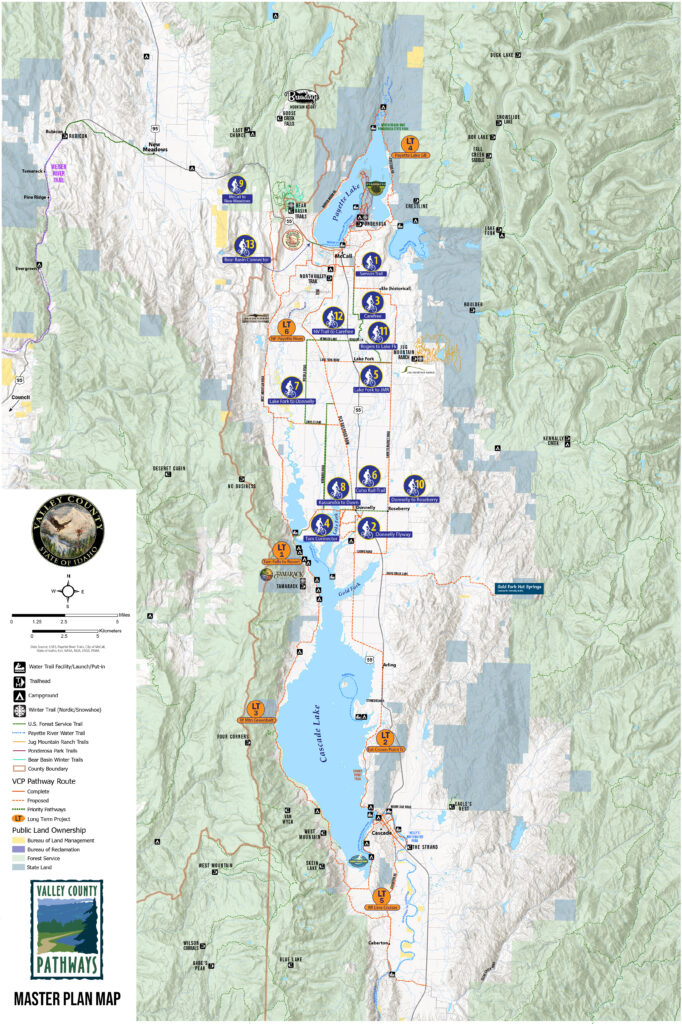
A north-south pathway system in Long Valley would seek to connect the communities of McCall, Donnelly, Lake Fork and Cascade, complete a pathway around Payette Lake, and establish a pathway corridor around Lake Cascade. To the maximum extent possible, the Valley County Pathway System would connect valley trails to community and neighborhood pathway networks, tourism amenities and services, parks, schools, natural areas, and national forest roads and trails.
See Pathway Vision Map, Attachment A
Mission Statement
The Valley County Pathways Committee developed the following mission statement for the valley-wide pathway system:
To create a north-south pathway system in Long Valley that links communities and fosters the development of pathway corridors along scenic transportation routes and our most prized natural resources, our lakes and rivers. The purpose of establishing a valley-wide pathway system is to enhance alternative transportation routes, tourism and recreation, economic development, and public health and safety.
Introduction: History and background
In July of 2004, a citizens group formed the Valley County Pathways Committee. For many years, people from different areas in Long Valley have thought about the potential of developing a valley-wide pathway system that could be used for walking, biking, running, roller-blading, horseback riding, commuting, cross-country skiing and snowmobiling. Most of this effort was focused in McCall. The Valley County Pathways Committee created an organization that would make a pathways system possible throughout the Long Valley region.
In traveling around the West, our committee members have experienced world-class pathway systems in Boise, Sun Valley, Coeur d’Alene, Spokane, Seattle, Summit County, Colorado and many other locations. We sense that a pathway system in Valley County would benefit our area in a similar way that these pathways have benefited their communities, in terms of creating safe and convenient pedestrian travel corridors, new recreation areas, a catalyst for economic development and more. The Long Valley area is well-endowed with a number of potential pathway corridors that appear to be feasible to develop into a valley-wide pathway system. However, we know that rapid residential and commercial development is booming throughout the valley, and that time is of the essence to reserve and develop strategic pathway corridors before they are lost. As a committee, we believe that Long Valley is one of the most beautiful places on earth, and as our economy flourishes and growth occurs, we owe it to our community and our grandchildren to seize the moment and develop a first-class pathway system that reflects our world-class setting.
To realize the goal of our vision statement, our committee believes that the first logical step in the process is to develop a concept master plan for a valley-wide pathway system. The concept master plan provides a blueprint for local government to use in future planning decisions related to new development and the creation and preservation of pathway corridors.
The Valley County Pathways Concept Master Plan is intended to dovetail with the City of McCall’s new master plan for biking and pedestrian pathways. The City of McCall has been working on developing a pathways network for over 10 years. A number of pathway segments have been built in the city limits, and the city’s master plan calls for linking those pathway segments into a unified pathway system. Under the fine leadership of Jug Mountain Ranch resident Shannon Munson, the McCall Pathways Committee has developed a new pathways map and brochure that describes the vision for the future (See Attachment B). Several important aspects of McCall’s master plan lie outside the city limits, such as a planned pathway around Payette Lake. The county’s plan needs to address this project to fulfill the dreams of dedicated citizens who worked long and hard to get the pathway started around the lake.
The Valley County Pathways master plan also is designed to dovetail with a new master plan endorsed in August by the Donnelly City Council for the Donnelly community. The city of Donnelly is an important terminal point in the valley on the northern end of Lake Cascade, where the old railroad right of way passes through, and where connections to Roseberry and Tamarack Resort need to occur.
We anticipate that the City of Cascade will develop a pathways master plan in the near future.
Purpose and Need
Why is it important for Valley County to develop a valley-wide pathway system?
Research and experience related to existing pedestrian pathway and greenway systems across the United States indicate that pathways create multiple public benefits.
Pathways:
□ Create new opportunities for recreation and for people to commute to work or shopping areas without using fossil fuels.
□ Boost local economies.
□ Provide transportation links to culturally or historically valuable areas.
□ Tie together parks, schools, waterways and communities.
□ Create opportunities for people to improve physical fitness and healthy lifestyles.
□ Enhance a community’s quality of life.
□ Preserve open space corridors.
- Create new pathways for recreation and for people to commute to work or shopping areas without using fossil fuels. New pathways not only create new convenient places for people to recreate, but they also provide a safer transportation corridor apart from streets and highways for people to travel by foot or bicycle to school, work or to community centers where they may need to shop, conduct business or visit friends and family.
- Boost local economies. Communities that have developed significant pathway systems have realized many economic benefits. Short-term economic benefits include trail-related
design, engineering and construction jobs, followed by increases in travel and tourism, hotel services, bed and breakfast establishments, and retail services such as restaurants, ice cream shops, and bicycle rental and repair shops.[3]
□ Across the United States, pathways and greenways are stimulating tourism and recreation-related spending. In the months following the opening of the Mineral Belt Trail in Leadville, Colo., the city reported a 19 percent increase in sales tax revenues.
□ The Great Allegheny Passage trail in Pennsylvania generated a positive economic impact of $14 million a year, according to a 1998 study, even though the trail was only half-completed at the time.[4]
□ The Mineral Wells to Weatherford Rail-Trail near Dallas, Texas, draws about 300,000 people annually and creates local revenues of $2 million a year, according to the National Transportation Enhancements Clearinghouse in 1999.
□ The Summit County (Colorado) Recreational Pathway System draws more than 500,000 visitors per year. An economic survey of Summit County pathway users showed that visitors generated $4.3 million in direct benefits to Summit County per year.
□ The 70-mile Trail of the Coeur d’Alenes between the Idaho-Montana border and Heyburn State Park near Plummer attracted at least 87,000 visitors in 2004, the first full year of operation, according to the Idaho Department of Parks and Recreation. New businesses have sprouted such as two bike shops, and business activity has increased according to hotel and restaurant owners in the Silver Valley.[5]
At the root level, pathway systems serve as the bedrock of tourism and travel business in a local community. They create transportation links between hotels, shops, restaurants, recreation areas, scenic areas and parks. They create safe, convenient places for hotel guests to go hiking, biking and sight-seeing right outside their door. In a place like Valley County, a pathway system on the valley floor creates a place for people to recreate at a beginning level on a user-friendly flat surface. As they develop endurance and skills, they may venture onto national forest trails, and discover a whole new experience.
- Provide transportation links to culturally or historically valuable areas. If pathway corridors were established between McCall and Cascade, and between Donnelly and Roseberry, there would be opportunities to create an interpretive historical tour of the valley, educating pathway visitors about the history of Long Valley from the standpoint of Native American occupation, the fur trapping era with Francois Payette, early white settlement by Thomas McCall and Finnish emigrants, and other pertinent information. Visitors will be drawn to the historic community of Roseberry to learn more details about our local history.
- Tie together parks, waterways and communities. Our committee’s vision seeks to connect Valley County communities such as McCall, Lake Fork, Donnelly, Cascade and Roseberry, and other neighborhoods around the valley such as Blackhawk Ranch, Jug Mountain Ranch and Tamarack Resort. The notion of linking our communities by pedestrian pathways can only be a positive thing. Linking the places where we live, work, learn and play with pathways is a crucial element in our nation’s effort to build safer, healthier, more livable communities.
Pathways reconnect us to our neighbors by creating common ground for social interaction. They reconnect us to our families by providing safe and healthy recreation areas for children, parents and grandparents. Pathways also can create safe routes to schools so children and their parents can commute to school in a safe environment away from busy streets and highways. Trails reconnect us to nature by giving us access to green space for recreation and relaxation.
- Create opportunities for people to improve physical fitness and healthy lifestyles. Pathways create healthy recreation and transportation opportunities by providing people of all ages with attractive, safe, accessible and low- or no-cost places to cycle, walk, hike, jog or skate. If pathways are located close to communities, they make it convenient for people to incorporate exercise into their daily routines. National trends show that Americans are increasingly becoming obese and suffer from health problems related to physical inactivity. The U.S. Department of Health and Human Services (HHS) estimated 129.6 million Americans, or 64 percent, are overweight or obese, which has been shown to increase the risk for developing heart disease, type 2 diabetes, some forms of cancer, and other disabling medical conditions. The Surgeon General recommends moderate physical activity – 30 minutes a day, five days a week – to combat the threat of diseases from obesity. Pathways provide a place for people to get regular exercise through walking the dog, commuting to work, walking to town and biking to school. Individuals must choose to exercise, but communities can make that choice easier by providing attractive and safe networks of sidewalks, bikeways and trails for people to use.
- Enhance a community’s quality of life. How people gauge their quality of life can be a subjective thing. But most national surveys show that communities with pathway networks have a higher quality of life profile than those without pathways. Quality of Life indices usually include things like education, employment, environment, health, human rights, income, infrastructure, public safety and recreation. If people have the option of accessing a pathway network near their home, and the pathway provides an opportunity for recreation and fitness, and gives them the option of walking or cycling to work instead of driving, they feel that their quality of life has been enhanced by having access to pathways. Parents who can send their kids to school on pathways feel their quality of life has been enhanced by not having to drive their kids to school, and knowing that their children will arrive to school safely.
- Preserve open space corridors. By creating pathway corridors, communities protect ribbons of open space that can also provide benefits to wildlife and the natural environment. While these benefits would not be the principal aim of the Valley County Pathways Committee, ribbons of open space that would be preserved through the creation of pathway corridors would be an ancillary benefit.
What is the urgency for creating a Valley County Pathway System?
Since Tamarack Resort was fully permitted and authorized to begin development in 2003, real estate development around the resort area and in Valley County in general has been sprouting at a frenetic pace. The number of building permits issued in Valley County in 2004 soared 30 percent from 459 in 2003 to 589. The number of building permits issued in the city of McCall nearly tripled between 2002 and 2004, from 124 to 356, according to the McCall Star-News. The building boom is happening from McCall to Cascade, and the formerly sleepy town of Donnelly is in the epicenter, with numerous projects now under construction and more on the way. The building boom has created numerous construction jobs, and it has created new economic vitality in the valley. This is positive news for everyone involved.
The Valley County Pathways Committee has been working hard to develop a concept master plan to present to the Valley County Planning & Zoning Commission in a timely fashion, knowing that new developments present new opportunities to develop existing and new pathway corridors. If the Valley County P&Z agrees with the Pathway Committee’s vision, we must act now to reserve key pathway corridors before they are bulldozed or paved over. As new subdivisions and other developments come before the P&Z Commission, the county can require project sponsors to provide an easement along key pathway corridors prior to approving a project.
Some developers will voluntarily reserve easements and pave pathways as part of their subdivision because they know it is a valuable amenity that will help sell homes and lots and elevate home values. Other developers may not want to invest in paving a pathway segment, but as long as the county reserves an easement in a key pathway corridor, the county and the pathways committee can work together to find ways to finance the development (see pathway funding options, page 25).
Other new developments proposed in Valley County may not necessarily overlie key pathway corridors, but they may present strategic opportunities for creating safe routes to schools, building links to nearby national forest lands or some other strategic value. Street-side bike lanes or sidewalks may suffice in these types of developments.
The bottom line is that the Valley County Pathways Committee will try to equip Valley County P&Z with a strategy that will allow development to move forward, while at the same time, add value to the county’s infrastructure in the form of new pathway corridors and pathway segments.
Public outreach/Public opinion regarding a Valley County pathway system
The Valley County Pathways Committee held a public open house in McCall in October to gauge public opinion about a Valley County pathways system. About 50 people attended the open house, including former members of the McCall Bike Path Committee, government officials and citizens. Everyone without exception was supportive of the pathways initiative. McCall Mayor Kirk Eimers came to the open house and commended our committee for launching the effort. “Keep it going, and give us a blueprint for future development,” Eimers said. “Your timing is perfect.”
Many people echoed Eimers’ sentiments. Former Valley County Commission Chairman Terry Gestrin attended and told us that our timing was crucial – because of the rapid growth in the area. New Valley County Commissioner Frank Eld also attended and presented the same message. After being elected to his first term, Commissioner Eld has indicated that it is one of his top priorities to develop pathways in Valley County. Commissioners Tom Kerr and Phil Davis also have expressed support for a Valley County Pathways System. All three commissioners voted to endorse a proposed 3-mile pathway $650,000 grant project from Tamarack Falls to West Mountain Campground. Valley County was the project sponsor.
More public surveys regarding pathway projects. Last year, the Idaho Department of Parks and Recreation conducted a public needs assessment through regional focus groups as part of Idaho’s Statewide Comprehensive Outdoor Recreation and Tourism Plan. The goal of the public needs assessment was to determine key recreation issues of importance and reveal issues related to unmet community recreation needs around the state. The study found that the third-highest issue identified by focus groups was the “need for more accessible public open spaces with trail connectivity to be included in urban planning.”

The 2000 Leisure Travel and Recreation Study[6], performed for the Idaho Department of Parks and Recreation, shows that hiking, horseback riding, mountain biking and cross-country skiing are among the most important recreation pursuits by residents and non-residents. The 2002 Idaho Outdoor Recreation Survey[7] shows that Idaho residents enjoy hiking and biking more than any other recreation activities. Clearly, there is strong public demand from residents and non-residents for the type of recreation opportunities that will be accessible to the public via the Valley County Pathways System.

Identification of Pathway Corridors
The Valley County Pathways Committee has identified a number of proposed pathway corridors in Long Valley that could create an outstanding linked pathway system in Long Valley. These corridors have been identified through talking with our Valley County neighbors, developers, business officials, county and local government officials. The proposed corridors are preliminary, and more field work is needed to meet with adjacent landowners and neighbors to gauge public support and identify any issues or concerns.
□ Old Railroad Right of Way – The Old Union Pacific Railroad Right of Way affords Valley County an opportunity to develop the longest pathway in Long Valley that wouldn’t be adjacent to a road or highway. This is critical because it will provide people with a nice pathway corridor away from motorized vehicles in a quiet setting. Nationwide, more than 11,500 miles of abandoned railroad right of way have been converted into recreation, transportation and greenway corridors since the 1960s.[8] Unfortunately, Union Pacific Railroad closed the old rail line between Cascade and McCall in 1979, four years before Congress passed “rail-banking” legislation that allows local governmental entities and non-profit groups to purchase abandoned railroad sections from railroad companies for the purpose of converting rail lines into them into trails. The Friends of the Weiser River Trail used rail-banking to acquire 83 miles of rail line between Rubicon and Weiser in the 1990s.
Soon after the line was abandoned, the old Union Pacific line between McCall and Cascade reverted into private ownership in many areas in Long Valley. However, portions of the Old Railroad ROW are still owned by the Bureau of Reclamation around Lake Cascade. Idaho Power Company purchased a 100-foot-wide easement along the Old Railroad ROW between McCall and Donnelly for the potential expansion of power lines in Long Valley. At the present time, IPC is examining a variety of corridors for expanding power lines between McCall and Cascade to 138 KV lines. The Valley County Pathways Committee has been in dialogue with Idaho Power Co. officials to explore the possibility of locating pathways underneath new power lines, and to explore alternatives for power line expansion.
Even though Idaho Power officials have indicated an interest in working with the Valley County Pathways Committee, it still will be essential to discuss the possibility of creating a pathway along the old railroad corridor with adjacent landowners prior to any action taken.
How the Old RR ROW could become part of the pathway system:
o Valley County could negotiate for easements from new developers when they come forth with new subdivision or development proposals before Valley County government.
o Valley County could acquire additional easements of the RR ROW as new funds became available (see funding section beginning on page 25)
o Adjacent landowners could voluntarily provide temporary easements to Valley County government for use of the RR ROW by signing a temporary access agreement. Temporary access agreements remove liability concerns for private landowners, and ensure that pathway sections receive periodic maintenance.
o The Bureau of Reclamation develops new pathway segments on the Old RR ROW on BOR land.
o Idaho Power could work with the Valley County Pathways Committee to locate a pathway between Donnelly and McCall.
Existing development prospects for RR ROW. One section of the Old RR ROW has been developed into a 2.5-mile dirt trail – the Crown Point Rail-Trail, beginning from a campground adjacent to Cascade Dam and heading north. Two additional sections of the RR ROW are slated for development by private developers – approximately 1 mile in the River Ranch area south of McCall, and one mile in a new proposed development called The Reserve at Lake Cascade between Kantola Lane and Day Star Lane.
□ Lake Cascade – There is great potential to develop pathway sections around Lake Cascade for two reasons: 1) The Bureau of Reclamation, a federal agency that manages the reservoir, owns roughly 65 percent of the property around the lake, and the Boise National Forest owns substantial portions of the southwest corner of the lake, bringing the total public ownership of the lakeshore to approximately 80 percent; 2) The BOR is supportive of developing a pathway around Lake Cascade from a policy level. In its 2002 Resource Management Plan for Lake Cascade, the BOR recommends Recreation Objective 2.10.3: “Seek opportunities to link trail segments over time into a contiguous system that stretches completely around the reservoir (Lake Cascade RMP, Page 5-36).”
The 2002 management plan also recommends the development of public trails in various areas around the lake, including between Tamarack Falls and the Osprey Point Group Use Site on the west side of the lake, and in some areas on the eastern side of the lake.
In January 2005, the Valley County Pathways Committee put together a grant application for developing a three-mile public pathway between Tamarack Falls and West Mountain Campground on a mix of Boise National Forest and BOR land. It does not appear that this grant application will succeed this year, but it is likely to succeed next year. The BOR also can assist with pathway funding requests through Congress.
□ Farm to Market Road – Farm to Market Road between McCall and Donnelly is a popular and scenic bicycle route. It provides access to many private homes along the road, the Jug Mountain Ranch development (325 home sites), Roseberry and several other historic sites. Because Farm to Market Road is a key access route to areas with public trails, such as in Jug Mountain Ranch, and to historic sites, it makes sense to study this corridor as a place for a detached pathway on the east or west side of the existing road. When new developments come along that require Valley County to expand the highway right of way to 100 feet, the county may be able to acquire an easement for a detached pathway at the same time. This is likely the most promising prospect for acquiring a pathway easement along Farm to Market Road.
It seems clear that if a pathway can be developed along Farm to Market Road, it would be immensely popular for local residents who may wish to commute to McCall or Donnelly or wherever they work or shop, and to locals and tourists who would use the pathway for recreation outings. If the pathways committee is successful in developing a pathway along the old Railroad Right of Way on the west side of Idaho 55, then we would develop a 30-mile loop system to travel to Roseberry, cross Idaho 55, and return to McCall via the RR ROW. Shorter loops could be accomplished if people went just as far south as Lake Fork Road and crossed Idaho 55 at that juncture.
□ West Mountain Road – The Valley County Pathways Committee has contemplated the need to develop a multiple-use pathway (i.e. open to motorized travel) between Donnelly and McCall. West Mountain Road seems to be the most logical choice for a motorized pathway corridor because it would provide a close link to No Business Saddle and Red Ridge, where there are additional motorized trails on National Forest land. The motorized concept would need further study and public input, but the committee thought this was worth pursuing because of the high number of residents in Long Valley who ride ATVs, motorcycles or snowmobiles.
Regardless of the motorized issue, a pathway corridor on West Mountain Road makes sense because it would connect the Blackhawk Ranch development to McCall. There are a number of other housing developments likely to occur along West Mountain Road between McCall and Donnelly. If the committee is successful in developing pathways between Tamarack Falls and Tamarack Resort, a pathway on West Mountain Road would provide a key link to Tamarack Resort and trails on the west side of Lake Cascade.
□ East Roseberry Road – Either striped bike lanes or a detached pathway should be developed between Donnelly and the historic town of Roseberry on Roseberry Road. Because of the existing popularity of Farm to Market road as a bicycle destination, and the potential to develop a loop system between Farm to Market Road and the old RR ROW back to McCall, East Roseberry Road should receive priority for funding and development.
□ West Roseberry Road – Ideally, a detached pathway or bike lanes at minimum should be developed between Donnelly and the junction of Roseberry and Norwood, connecting to the future extension of a detached pathway from West Roseberry to Tamarack Falls.
□ East Lake Fork Road – Existing bike lanes have been striped between Jug Mountain Ranch and Lake Fork on East Lake Fork Road. If this road becomes a major collector, it would make sense to widen the bike lanes or work on developed a detached pathway on this section of road.
□ West Lake Fork Road – It may make sense to work toward striped bike lanes or a detached pathway on West Lake Fork Road in the event that the old RR ROW is developed into a pathway from Donnelly to McCall. This would allow cyclists to travel out to Lake Fork either on the old RR ROW or on Farm to Market Road, and then loop back to town.
□ Old State Highway – South of the Gold Fork Arm, the Valley County Road & Bridge Department plans on getting a 100-foot right of way along Old State Highway between Kantola Lane and points north to the point where the highway goes into the Gold Fork Arm of the reservoir. This right of way will allow for a detached pathway on Old State Highway in the future.
□ Kantola Lane/Day Star/West 4 – Kantola Lane will become a major transportation corridor, a “collector,” as the primary entrance to The Reserve at Lake Cascade. Day Star Lane, on the north boundary of the development, will become another major road corridor with a 100-foot ROW. And West 4 also will become a major collector to serve existing neighborhoods and new developments. The Pathways Committee recommends that the county should develop a detached pathway on Day Star Lane to connect to Old State Highway, then to either West 4 or Kantola as a bike lane loop for local residents in the future. Further, the committee believes that the county should develop detached pathways along Day Star Lane on the south side of the road, on the east side of Old State Highway, and on the south side of West 4 so that the pathways run alongside new developments.
□ Day Star/Homer/Beverly – As Day Star turns south, the pathway committee recommends a detached pathway continuing on the east side of Day Star. Where Day Star connects with Homer, the detached pathway should continue on the south side of Homer to Beverly, and then on the east side of Beverly.
□ Norwood Lane – If the RR ROW corridor does not pan out as a regional pathway corridor, Norwood is expected to become another major collector road between McCall and Donnelly in the middle of the valley. This road would become a good alternative to the RR ROW corridor if the need arises, and if it doesn’t, then Norwood may be close enough to the RR ROW that new developments proposed in this area should be required to develop connecting pathways or bike lanes at minimum.
□ North Fork Payette River – In the vicinity of Smiley Lane and Hartsell Bridge, the North Fork of the Payette River is bounded by several large tracts of BLM land and one tract of state land. If it is possible to develop pathways on either side of the river in this area, that may connect to the future pathway on West Mountain Road, that would be an appropriate long-term goal for the regional pathway system.
A pathway in this area would dovetail with the potential of building a pathway along the North Fork Arm of the Payette River running south to Lake Cascade from Hartsell Bridge.
□ Cabarton Road – Cabarton Road is a rural scenic byway from points south of Cascade to Clear Creek. A detached pathway on Cabarton Road south of Cascade would make sense because it is a very scenic corridor that eventually runs along the Payette River.
□ Other regional corridors will emerge as Long Valley becomes developed for housing and commercial development. The Valley County Pathways Committee and Valley County government should watch for these developments and amend the pathways concept master plan accordingly to follow growth.
Goals
The following is a list of goals that will help our communities achieve an overarching goal of establishing a viable and enduring Valley County Pathways System in a timely manner:
Goal 1. The Valley County Planning and Zoning Department should adopt the Valley County Pathways Concept Master Plan and incorporate its goals and proposed pathway corridors into the Valley County Comprehensive Plan. The plan should create a priority system for developing Class I and Class II pathways
Goal 2. The Valley County Pathways Committee should work with Valley County government to determine how to pay for the acquisition of easements, fund the development of new pathways and provide regular financial support for pathway maintenance. See next section on “Funding Opportunities for Pathways.”
Goal 3. The Valley County Planning and Zoning Department should require individuals and developers who propose new developments and subdivisions to blend their proposals into the vision for a valley-wide pathways system. The best way to do this would be for Valley County P&Z officials to recommend developers and individuals to meet with the Valley County Pathways Committee about their new development or subdivision in the early stages of planning and design.
Goal 4. The Valley County Planning and Zoning Commission should obtain pathway right of way easements from new developments in cases where the development overlies key pathway corridors. Such easements should be held by Valley County government.
Goal 5. The Valley County Planning and Zoning Department should require individuals and developers who are creating new subdivisions or other developments to develop finished pathways. If a new, benevolent developer chooses to build a finished pathway, following the desired statewide pathway standards, they should receive development credits in some fashion to compensate them for contributing to the valley-wide pathway system.
Goal 6. The Valley County Pathways Committee should work with the Valley County Road and Bridge Department to collaboratively look for opportunities to incorporate pedestrian and bicycling facilities into the design of road and bridge projects in areas where regional pathways are proposed and elsewhere.
Goal 7. The Valley County Pathways Committee should work with existing landowners and subdivision owners to obtain temporary access agreements to key pathway corridors in high-priority areas. These negotiations need to be done in a way that respects landowners’ private property rights. Any temporary access agreements signed with landowners should be held by Valley County government. Over the long term, efforts should be under taken to finalize access agreements into permanent easements, as funding and negotiations allow.
Goal 8. In new development areas where potential links to the regional valley-wide pathway system can be established, developers should be strongly encouraged to create neighborhood pathways, bike lanes and/or sidewalks to encourage and accommodate safe pedestrian travel to regional pathways.
Goal 9. The Valley County Pathways Committee should work in a collaborate fashion with the Valley County Road and Bridge Department, Valley County schools, city governments and state parks to increase communication about the potential for developing pathways to create safe routes to schools and parks.
Goal 10.Valley County should create a program to provide regular maintenance, sweeping, pavement repairs, striping and signs along pathways and bike lanes.
Goal 11. The Valley County Pathways Committee should ensure that pathway master plans developed for the cities of McCall, Donnelly and Cascade and Valley County are consistent and in synch with each other and the Valley County Pathway Master Plan.
Goal 12.The Valley County Pathways Committee should develop a design standard for pathway signage and develop a system of signs that maintain a consistent character and design. Such signs should be placed throughout the pathway system as it is developed.
Goal 13.The Valley County Pathways Committee should develop a map and brochure of the Valley County Pathway System in the early stages of development, and update the map over time, as needed, to keep it current.
Funding Opportunities for Pathways
Local and State Funding Sources
Bond Referendums for Greenways. Communities across the nation have successfully placed on local ballots propositions to support greenway development. The Charlotte-Mecklenburg County, NC area passed four consecutive referendums that generated more than $3 million for greenways. Guilford County, NC passed a referendum in 1986 that appropriated $1.6 million for development of a specific greenway corridor. In Cheyenne, Wyoming, a greenway bond referendum was used to fund the first three miles of local greenways. Residents throughout the United States have consistently placed a high value on local greenway development and voted to raise their own taxes in support of greenway implementation. However, this option requires a 66.6% majority in Valley County to succeed – a very high bar indeed.
Serial levy. Idaho State Code provides cities and counties with the authority to raise funds for temporary two-year supplemental property tax levies. The city of Boise used this financial instrument to raise $10 million for the purchase of open space in the Boise Foothills to protect open space, recreation trail corridors, wildlife habitat and watershed values. The measure required a simple majority to pass, and it passed by a 60 percent favorable vote in May 2001. It required a comprehensive grass-roots campaign to pass the serial levy. Although a serial levy raises property taxes, it only does so for a two-year period. This makes the levy increase easier to swallow for voters, knowing it won’t last forever, like school levies and jail bonds.
Creation of a Recreation District. Blaine County has made strong gains in the creation of public trails and pathways and other recreation facilities through the passage of a county-wide recreation district. The Blaine County Recreation District has an annual budget of about $600,000 per year. State law limits the size of property tax levies for recreation districts to .06 percent of the taxable value of a district. The size of a district is discretionary. Boundaries can be drawn to coincide with the area where public benefits would be provided. Under state law, recreation districts can charge user fees, and they can use their funds for purchasing private land or easements. They also can accept donations of private property. . The South County Recreation District in Valley County raises funds for a planned community center and swimming pool. It may be possible to expand the recreation district boundaries to create an ongoing operations and maintenance fund for pathways in Valley County.
Local-option sales tax. This is a potential tool for so-called “resort cities” in Idaho, cities with a population of fewer than 10,000 people whose principal economy is based around tourism and recreation. However, this tool is not available to counties in the state of Idaho for recreation and parks purposes.
Impact fees. Idaho State law allows cities and counties to collect impact fees on development. There is a multi-step process for determining what type of impact fees would be charged, and what it would be used for. The city of Boise charges five impact fees for parks that total $655.70 for single-family homes. Summit County, Colorado, charges parks and open space impact fees that total $520 for single-family homes. State law provides for a multi-step process for developing impact fees. It might behoove the county to appoint a special panel consisting of community members, developers, real estate professionals and government officials to develop recommendations for impact fees.
Greenway Trust Fund. Another strategy used by several communities is the creation of a trust fund for land acquisition and facility development that is administered by a private greenway advocacy group, or by a local greenway commission. A trust fund can aid in the acquisition of large parcels of high-priority properties that may be lost if not acquired by private sector initiative. Money may be contributed to the trust fund from a variety of sources, including the municipal and county general funds, private grants, and gifts.
Local Private-Sector Funding. Local industries and private businesses may agree to provide support for greenway development through one or more of the following methods:
- Donations of cash to a specific greenway segment
- Donations of services by local businesses to reduce the cost of greenway implementation, including equipment, materials and labor to construct and install elements of a specific greenway
- Reductions in the cost of materials purchased from local businesses that support greenway implementation and can supply essential products for facility development
One example of a successful endeavor of this type is the Swift Creek Recycled Greenway in Cary, NC. A total of $40,000 in donated construction materials and labor made this trail an award-winning demonstration project. This method of raising funds requires a great deal of staff coordination. (Note: Some materials used in the “recycled trail” were considered waste materials by local industries!)
Adopt-A-Trail Programs. These are typically small grant programs that fund new construction, repair/renovation, maps, trail brochures, facilities (bike racks, picnic areas, birding equipment).
State Water Management Funds. Funds established to protect or improve water quality could apply to a greenways/trails project if a strong link exists between the development of a greenway and the adjacent/nearby water quality. Possible uses of these funds include: purchase critical strips of land along rivers and streams for protection which could then also be used for greenways; develop educational materials, displays; or for storm water management.
Volunteer Assistance and Small-Scale Donation Programs
Greenway Sponsors. A sponsorship program for greenway amenities allows for smaller donations to be received both from individuals and businesses. The program must be well planned and organized, with design standards and associated costs established for each amenity. Project elements that may be funded can include mile markers, call boxes, benches, trash receptacles, entry signage and bollards, and picnic areas.
Estate Donations. Wills, estates and trusts may be dedicated to the appropriate agency for use in developing and/or operating the greenway system. By naming a pathway after the donator, a “legacy” relationship may be established as an incentive to support pathway development.
“Buy-a-Foot” Programs. “Buy-a-Foot” programs have been successful in raising funds and awareness for trail and greenway projects within North Carolina. Under local initiatives, citizens are encouraged to purchase one linear foot of the greenway by donating the cost of construction. An excellent example of a successful endeavor is the High Point Greenway “Buy-a-Foot” campaign, in which linear greenway “feet” were sold at a cost of $25/ foot. Those who donated were given a greenway T-shirt and a certificate. This project provided over $5,000 in funds.
Federal Government Funding Sources
Some Federal programs offer financial aid for projects that aim to improve community infrastructure, transportation, housing and recreation programs. Some of the Federal programs that can be used to support the development of greenway systems include:
The Transportation Equity Act for the 21st Century (TEA-21). The primary source of federal funding for greenways is through the Transportation Equity Act for the 21st Century (TEA-21). There are many sections of the Act that support the development of bicycle and pedestrian transportation corridors. Those sections that apply to the creation of greenway systems include:
Section 1302 – Symms National Recreational Trails Fund Act (NRTFA): A component of TEA-21, the NRTFA is a funding source to assist with the development of non-motorized and motorized trails. In fiscal year 1994, Congress did not fund this national program, and it has become apparent that this funding source is not as stable as the national trail community once envisioned it. In 1993, Congress appropriated only $7.5 million of a $30 million apportionment. The Act uses funds paid into the Highway Trust Fund from fees on non-highway recreation fuel used by off-road vehicles and camping equipment.
Motorized and non-motorized trail projects receive a 30-percent share of annual appropriations. Forty percent of the appropriation must be spent on projects that accommodate both user groups. States can grant funds to private and public sector organizations. NRTFA projects are 100-percent federally funded during the first three years of the program. Grant recipients must provide a 20-percent match.
Section 1047 – National Scenic Byways Program: This component of TEA-21 is designed to protect and enhance America’s designated scenic roads. Money is available for planning, safety and facility improvements, cultural and historic resource protection, and tourism information signage. Bicycle and pedestrian facilities can be developed in conjunction with scenic roadway projects. Some states with Scenic Byway Programs have developed greenways in conjunction with this initiative.
Community Development Block Grant Program (CDBG). The U.S. Department of Housing and Urban Development (HUD) offers financial grants to communities for neighborhood revitalization, economic development, and improvements to community facilities and services, especially in low and moderate-income areas. Several communities have used HUD funds to develop greenways, including the Boscobel Heights’ “Safe Walk” Greenway in Nashville, Tennessee.
Land and Water Conservation Fund (LWCF) Grants. This Federal funding source was established in 1965 to provide “close-to-home” park and recreation opportunities to residents throughout the United States. Money for the fund comes from the sale or lease of nonrenewable resources, primarily federal offshore oil and gas leases and surplus federal land sales. LWCF grants can be used by communities to build a variety of parks and recreation facilities, including trails and greenways.
LWCF funds have been used to build pathways and greenbelt segments throughout the state of Idaho. LWCF also have been used to purchase easements for trails in general and to purchase scenic easements in the Sawtooth National Recreation Area. Communities must match LWCF grants with 50-percent of the local project costs through in-kind services or cash. All projects funded by LWCF grants must be used exclusively for recreation purposes, in perpetuity.
Southwest Idaho Resource Advisory Council. This body can fund projects on federal lands for various amounts in the five- to six-figure range. Projects must have the support of the Boise National Forest. Valley County Commissioner Phil Davis and County Public Lands Coordinator Lois Van Hoover are members of the Southwest Idaho RAC.
Conservation Reserve Program. The U. S. Department of Agriculture (USDA), through its Agricultural Stabilization and Conservation Service, provides payments to farm owners and operators to place highly erodible or environmentally sensitive landscapes into a 10-15 year conservation contract. The participant, in return for annual payments during this period, agrees to implement a conservation plan approved by the local conservation district for converting sensitive lands to less intensive uses. Individuals, associations, corporations, estates, trusts, cities, counties and other entities are eligible for this program. Funds from this program can be used to fund the maintenance of open space and non-public-use greenways, along bodies of water and ridgelines.
Wetlands Reserve Program. The U.S. Department of Agriculture provides direct payments to private landowners who agree to place sensitive wetlands under permanent easements. This program can be used to fund the protection of open space and greenways within riparian corridors.
Watershed Protection and Flood Prevention (Small Watersheds) Grants. The USDA Natural Resource Conservation Service (NRCS) provides funding to state and local agencies or nonprofit organizations authorized to carry out, maintain and operate watershed improvements involving less than 250,000 acres. The NRCS provides financial and technical assistance to eligible projects to improve watershed protection, flood prevention, sedimentation control, public water-based fish and wildlife enhancements, and recreation planning. The NRCS requires a 50-percent local match for public recreation, and fish and wildlife projects.
Urban and Community Forestry Assistance Program. The USDA provides small grants of up to $10,000 to communities for the purchase of trees to plant along city streets and for greenways and parks. To qualify for this program, a community must pledge to develop a street-tree inventory, a municipal tree ordinance, a tree commission, committee or department, and an urban forestry-management plan.
Small Business Tree-Planting Program. The Small Business Administration provides small grants of up to $10,000 to purchase trees for planting along streets and within parks or greenways. Grants are used to develop contracts with local businesses for the plantings.
Economic Development Grants for Public Works and Development of Facilities. The U. S. Department of Commerce, Economic Development Administration (EDA), provides grants to states, counties and cities designated as redevelopment areas by EDA for public works projects that can include developing trails and greenway facilities. There is a 30-percent local match required, except in severely distressed areas where federal contribution can reach 80 percent.
National Recreational Trails Program. These grants are available to government and non-profit agencies, for amounts ranging from $5,000 to $50,000, for the building of a trail or piece of a trail. It is a reimbursement grant program (sponsor must fund 100% of the project up front) and requires a 20% local match. This is an annual program, with an application deadline at the end of January. The available funds are split such that 30% goes towards motorized trails, 30% to non-motorized trails, and 40% is discretionary for trail construction. The Idaho Department of Parks and Recreation administers this program in the state of Idaho.
Design Arts Program. The National Endowment for the Arts provides grants to states and local agencies, individuals and nonprofit organizations for projects that incorporate urban design, historic preservation, planning, architecture, landscape architecture and other community improvement activities, including greenway development. Grants to organizations and agencies must be matched by a 50-percent local contribution. Agencies can receive up to $50,000.
Grants through Private Foundations and Corporations
Many communities have solicited greenway funding from a variety of private foundations and other conservation-minded benefactors. Some grants are:
American Greenways Eastman Kodak Awards. The Conservation Fund’s American Greenways Program has teamed with the Eastman Kodak Corporation and the National Geographic Society to award small grants ($250 to $2000) to stimulate the planning, design and development of greenways.
REI Environmental Grants. Recreational Equipment Incorporated awards grants to nonprofit organizations interested in protecting and enhancing natural resources for outdoor recreation. The company calls on its employees to nominate organizations for these grants, ranging from $500 to $8,000, which can be used for the following:
· Protect lands and waterways and make these resources accessible to more people
· Better utilize or preserve natural resources for recreation
· Increase access to outdoor activities
· Encourage involvement in muscle-powered recreation
· Promote safe participation in outdoor muscle-powered recreation, and proper care for outdoor resources
Coors Pure Water 2000 Grants. Coors Brewing Company and its affiliated distributors provide funding and in-kind services to grassroots organizations that are working to solve local, regional and national water-related problems. Coors provides grants, ranging from a few hundred dollars to $50,000, for projects such as river cleanups, aquatic habitat improvements, water quality monitoring, wetlands protection, pollution prevention, water education efforts, groundwater protection, water conservation and fisheries.
Bikes Belong. Bikes Belong Coalition is sponsored by members of the American Bicycle Industry. The grant program is a national discretionary program with a small budget, to help communities build TEA-21-funded projects. They like to fund high-profile projects and like regional coalitions. An application must be supported by the local bicycle dealers (letters of support should be attached). Bikes Belong also offers advice and information on how to get more people on bikes. Government and non-profit agencies are eligible and no match is required. The maximum amount for a grant proposal is $10,000. Applications may be submitted at any time and are reviewed as they are received.
Wal-Mart Foundation. This foundation supports local community and environmental activities and educational programs for children (among other things). An organization needs to work with the local store manager to discuss application. Wal-Mart Foundation only funds 501(c)3 organizations.
Idaho Foundation for Parks and Lands. Founded in 1972, the Idaho Foundation for Parks and Lands is a statewide public benefit privately funded organization whose mission is to preserve and protect open space lands and unique natural, scenic settings for public benefit through various flexible conservation methods. The Foundation has been instrumental in the purchase of valuable lands and easements for state parks, greenbelt pathways, blue-ribbon trout streams and more. The Foundation’s board president is Don K. Weilmunster.
Pathway Development – Design Standards
National standards and guidelines have been developed for pedestrian pathways (cite ASHTO). These standards and guidelines have been embraced by the Idaho Transportation Department and other states to protect the safety of pathway users and to provide a consistent policy direction to highway planners and engineers.
ASHTO design guidelines divide pathways into two categories: separate/detached pathways (Class I) and road-side bike lanes (Class II).
Definitions:
Pathways are defined as facilities that provide for pedestrian and bicycle travel.
A Class I Pathway or Bike Path provides for multi-use two-way travel completely separated and detached from any streets or roads. The pathways should comply with standards and guidelines developed under the American Disabilities Act.
A Class II Pathway or Bike Lane provides a striped lane for one-way bike travel along a street or highway auto travel lane. Bike Lanes are intended to delineate the portion of the right of way assigned to bicycles and automobiles and to provide for more predictable movements by each.
A Class I Separated Multiple-Use Path is physically separated from motor vehicle traffic by open space or barrier, and it may be within the roadway or independent right of way.

Where a separated path parallels a roadway, there must be a 5-foot minimum width separating the pathway from the roadway, or a physical barrier of sufficient height (4.5 feet) minimum must be installed.
A 10-foot standard width must be used for a separated multiple-use path. Paths should be 12 feet wide in areas with high bicycle volume or where they are used by a combination of bicyclists, pedestrians, skaters and joggers. A minimum of 2 feet graded area should be maintained adjacent to both sides of the pavement to provide clearance (shy distance) from poles, tress, fences, and other obstructions. Because of the relatively low number of public users expected in the short-term, and with limited budgets in mind, the
Valley County Pathways Committee recommends a 10-foot standard for paved Class I pathways.
Separated multiple-use pathways are the safest for travel and create opportunities for recreation besides bicycling.
A Class II Bike Lane is a portion of the roadway that is designated for preferential use by bicyclists.
Bike lanes are established on arterial and collector streets. The minimum width for a bike lane is 4 feet or 5 feet from the face of a curb or guardrail. There should be a clear riding zone of 4 feet if there is a longitudinal joint between the pavement and the curb-and-gutter section. Bike lanes in excess of 6 feet wide are undesirable as they may be mistaken for a motor vehicle lane or parking area.

Bike lanes must always be well marked and signed to call attention to their preferential use by bicyclists.
If parking is permitted, the bike lane must be placed between parking area and the travel lane and have a minimum width of 5 feet.
Bike lanes must always be one-way facilities and carry bicycle traffic in the same direction as adjacent motor vehicle traffic. Bike lanes on one-way streets should be on the right side of the roadway, except in areas were a bike lane on the left will decrease the number of conflicts.
Recommended Implementation schedule
Highest-priority projects:
· Work with Idaho Power Co. and adjacent landowners to obtain an easement on the old Railroad ROW from the River Ranch subdivision south of McCall to the city of Donnelly.
· Work with developers at The Reserve at Lake Cascade to support the acquisition of a public easement on the old RR ROW as it runs north-south through the private open space development. Additionally, the county should work plan Class I pathways on the south side of Day Star Lane and on the north side of Kantola Lane to connect with a separate pathway on Old State Highway. The pathways committee intends to work with the developers of Gold Fork Bay Village, Songbird and others to work on a Class I pathway to Idaho Highway 55 and portions of the old RR ROW.
· Develop short-term priority pathway sections identified in the Bureau of Reclamation’s 2002 Resource Management Plan. Four particular pathway segments are identified in the RMP:
o Tamarack Falls to Osprey Point Group Use Camp Site.
o North Fork arm of Lake Cascade near West Mountain Road.
o Develop a loop system starting from the Sugarloaf boat ramp and campground and running around the Sugarloaf peninsula.
o Van Wyck Park to the southern tip of Lake Cascade.
· In the area bordering Lake Cascade to the south of the Gold Fork arm of Lake Cascade, convert the old RR ROW into a public pathway corridor through obtaining easements from new developments, negotiating access agreements from existing rural landowners, and negotiating access agreements from BOR agricultural lessees.
· In the area north of the Gold Fork arm of Lake Cascade, between Wagon Wheel/SISCRA and the city of Donnelly, convert the old RR ROW into a public pathway corridor through obtaining easements from new developments and negotiating access agreements with existing subdivision owners and rural landowners.
· Connect Whitetail Greenbelt with West Mountain Road Pathway Corridor.
· Launch an engineering study to determine how to complete a public pathway around Payette Lake.
· Develop detached pathways between the city of Donnelly and Tamarack Falls on West Roseberry Road. As soon as possible, the county should determine the feasibility of locating a detached pathway on the north or south side of West Roseberry.
· Develop additional pathway projects along West Mountain Road on BOR and USFS land between Osprey Point and the southern end of Lake Cascade.
· Negotiate access agreements with various private landowners and subdivisions along the old RR ROW between Kantola Lane and the Crown Point Rail-Trail on BOR land near Cascade Dam.
· Look for opportunities to develop detached pathways on county roadways leading to national forest lands.
· Develop a detached pathway along Cabarton Road from Clear Creek to the city of Cascade.
Thumbnail cost estimates for building pathways
The cost of building asphalt or compacted surface pathways seems to vary widely, depending on whether projects are funded on a local, state or federal level, and whether design and engineering costs are completed in-house or by a consulting engineering firm. A number of thumbnail estimates follow from a variety of sources.
Parametrix, a design and engineering firm which currently serves as Valley County’s consulting engineer, has researched costs for design leading to construction of paved 10-foot separated pathway projects for the McCall area. Parametrix has done a number of pathway design projects throughout the Pacific Northwest. They looked at recent average costs for resort community pathway systems. These cost factors are computed in 2005 dollars.
For typical pathways in flat or rolling terrain, construction costs would range from $300,000 to $600,000 per mile. In steeper mountainous terrain, such as around Payette Lake, construction costs could be $1,000,000 or more per mile. Design costs would vary substantially depending on funding sources. If local funds are used, design costs (assuming no Rights of Way or structures are included) would vary between 15%-20% of construction costs, or $40,000 to $100,000 per mile. If federal funds are used, the design costs would increase to 40% or 50% of construction costs because of environmental and other requirements.
Boise Parks & Recreation Department experience: The Boise Parks and Recreation Department uses a thumbnail of $150,000 per mile for a 12-foot asphalt pathway, using in-house design and engineering services.
Tamarack Pathway experience: Tamarack Resort has constructed more than five miles of 8-foot-wide cart paths in the resort’s Osprey Meadows Golf Course. Tamarack’s thumbnail estimate for building asphalt cart paths has been running approximately $2.50 per square foot, including excavation, clearing, material costs, asphalt and preparation. Using this thumbnail, a 5-mile pathway 10 feet wide would cost about $132,000.
Strawberry Construction has built a number of wooden bridges 12 feet wide on Tamarack’s golf course. The thumbnail cost for the bridges has been about $500 per linear foot. The bridges can be anchored by prefabricated abutments on either side.
All of these estimates are provided to give Valley County Planning & Zoning Commission members and the Valley County Commissioners an idea of how much it will cost to build pathways on a per-mile basis.
Conclusion
The Valley County Pathways Committee envisions that it will take many years – perhaps more than 20 – to realize the vision of a pathway system that the committee has laid out before you with this concept master plan. It will take time to obtain easements and rights of way for pathways, and it will take time to secure funding sources for pathway development. But our committee feels it is of paramount importance to get a master plan adopted by the county to help with planning future growth in Long Valley to create a foundation for developing a world-class pathway system.
The committee stands ready to work with the Valley County Planning and Zoning Department, as well as with the Valley County Road and Bridge Department, to begin work in earnest on a Valley County Pathways System. The first step in realizing the vision will be for the Valley County Planning and Zoning Commission to adopt the master plan and its goals as part of the Valley County Comprehensive Plan.
Thank you for considering our concept master plan.
[1] 2003-2007 Statewide Comprehensive Outdoor Recreation and Tourism Plan, Outdoor Recreation Data Center, Rick Just, coordinator, Idaho Department of Parks and Recreation, 2003.
[2] Ibid.
[3] “Economic Benefits of Trails and Greenways,” Trails and Greenways Clearinghouse, a project of the Rails-to-Trails Conservancy, web site, 2005.
[4] “An Economic Impact Study for the Allegheny Trail Alliance,” Stephen Farber, University of Pittsburg and Pennsylvania Economy League, Inc., January 1999, i-ii.
[5] Personal communication, Bill Scudder, Park Manager, Cataldo State Park, and supervisor of theTrail of the Coeur d’Alenes, in Cataldo, Idaho, July 5, 2005.
[6] 2003-2007 Statewide Comprehensive Outdoor Recreation and Tourism Plan, Outdoor Recreation Data Center, Rick Just, coordinator, Idaho Department of Parks and Recreation, 2003.
[7] Ibid.
[8] Rails-to-Trails Conservancy (RTC), a non-profit organization, founded in 1986.